
When you hear the word elopement, what comes to mind?
Maybe you picture two people quietly getting married somewhere beautiful with no guests and very little planning.
Maybe you imagine a quick courthouse ceremony.
Or maybe you've seen those incredible photos of couples exchanging vows on a mountaintop, beside a vineyard, along the coast, or beneath a canopy of redwoods and wondered:
What actually happens during an elopement ceremony?
The answer is wonderfully simple:
An elopement ceremony can look however you want it to look.
There is no requirement that an elopement follow a traditional wedding format. You can keep it short and simple, include meaningful traditions, write personal vows, invite a few loved ones, or make the entire day an experience centered around the two of you.
If you're considering a Sonoma County or Wine Country elopement, here's what a typical elopement ceremony might look like—from the moments leading up to your vows through the celebration afterward.

First: An Elopement Is Still a Wedding
One of the biggest misconceptions about elopements is that they're somehow less of a wedding.
They aren't.
An elopement simply gives you the freedom to decide what matters most to you without having to build your day around a large guest list, elaborate reception, or traditional wedding schedule.
You can still have:
- A beautiful location
- A personalized ceremony
- Wedding attire you love
- Meaningful vows
- Rings
- Family traditions
- Readings
- A first kiss
- Photographs
- Flowers
- Champagne or a special meal afterward
- An unforgettable adventure
The difference is that you get to decide what belongs.
Before the Ceremony: Enjoy the Moment
An elopement day doesn't have to begin with rushing straight to the ceremony.
In fact, one of the advantages of an elopement is having more flexibility with your schedule.
You might begin with breakfast together, spend the morning getting ready, explore your location, take photographs, or simply enjoy a quiet moment before the ceremony.
If you're eloping somewhere in Sonoma County, you might spend part of the day exploring the area before heading to your ceremony location.
The day can feel less like a series of appointments and more like an experience you're sharing together.
Arriving at Your Ceremony Location
Eventually, you'll arrive at the place where you're going to exchange your vows.
This might be:
- A vineyard
- A garden
- A redwood grove
- A private estate
- A scenic overlook
- A beach
- A favorite outdoor location
- A courthouse or city setting
- Somewhere that has personal meaning to you
Your ceremony location doesn't have to be elaborate.
Sometimes the most meaningful location is simply somewhere where the two of you feel comfortable and connected.
The Ceremony Begins
An elopement ceremony can begin with something as simple as the two of you standing together.
If you have guests, they may be seated or gathered nearby.
If it's just the two of you, your officiant can welcome you and begin the ceremony.
There doesn't have to be a dramatic processional.
There doesn't have to be a traditional aisle.
And there certainly doesn't have to be a large audience.
Your officiant can help you create an opening that fits the setting and the feeling you want for the day.
A Few Words About Your Relationship
Even a short elopement ceremony can include your story.
Your officiant might share a few words about how you met, what brought you together, or what makes your relationship special.
This doesn't need to be a ten-minute biography.
A few carefully chosen details can help create a ceremony that feels personal and gives the moment context.
After all, you're not simply standing in a beautiful location getting married.
You're there because of everything that brought you to that moment.
Readings, Traditions & Meaningful Elements
Just because you're eloping doesn't mean you have to leave out the things that matter to you.
You can include a reading, cultural tradition, religious element, unity ritual, or another meaningful part of a traditional wedding ceremony.
You can also create something entirely your own.
Maybe you want to read a favorite poem.
Maybe you want to honor your family.
Maybe there's a particular tradition that has special meaning to you.
Or maybe you don't want any additional elements at all.
That's perfectly fine.
One of the great things about an elopement is that you don't have to include something simply because it's expected.
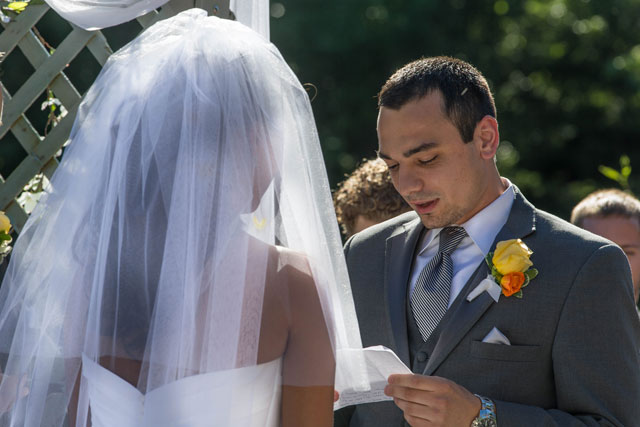

Your Vows
Then comes one of the most personal parts of the ceremony: your vows.
Some couples write their own.
Others prefer traditional vows.
Some want several paragraphs. Others want just a few simple promises.
There is no correct way to write wedding vows.
The best vows sound like the people saying them.
They might include promises for the future, memories from your relationship, things you love about each other, or even a little humor.
And if you're nervous about speaking your vows aloud, you're certainly not alone.
Your officiant can help you understand what to expect and make sure you know when it's your turn to speak.
The Ring Exchange
After the vows, many couples exchange rings.
Your officiant may introduce the ring exchange with a few words about what the rings represent before guiding you through the exchange.
Or you may prefer to keep it very simple.
There is no need to turn the ring exchange into a lengthy production.
The meaning is in the moment.
The Pronouncement
Once you've completed your ceremony, your officiant will pronounce you married.
And then comes one of the most anticipated moments of the day:
Your first kiss as a married couple.
Even when there are only two people standing there, it can be an incredibly emotional moment.
And Then...You're Married!
One of the wonderful things about an elopement is that there doesn't have to be a mad dash to the next event.
You can take a breath.
Laugh.
Hug.
Take it all in.
Your photographer may capture some portraits immediately after the ceremony, or you may simply spend some time together before moving on to the next part of your day.
You just got married.
You don't have to rush past that moment.
What Happens After an Elopement Ceremony?
This is where elopements can become especially fun.
You can celebrate however you want.
Maybe you go to a beautiful restaurant for dinner.
Maybe you have a picnic.
Maybe you open a bottle of wine and watch the sunset.
Maybe you hike somewhere you've always wanted to visit.
Maybe you spend the afternoon exploring Sonoma together.
Or maybe you head back to your hotel, order room service, and spend the evening enjoying the fact that you're officially married.
There is no reception schedule to follow.
The rest of the day belongs to you.
What If We Want a Few Guests?
Eloping doesn't necessarily mean you have to be completely alone.
Some couples invite their closest family members or friends.
Others have a handful of guests attend the ceremony and then spend the rest of the day privately together.
The important thing is deciding what makes the day feel right for you.
If you want your parents there, invite them.
If you want your best friend to stand beside you, include them.
If you want the entire day to be just the two of you, that's wonderful too.
An elopement doesn't have to fit someone else's definition.
How Long Does an Elopement Ceremony Take?
An elopement ceremony can be quite short, but it doesn't have to be rushed.
A simple ceremony might take around 10–15 minutes.
A more personalized ceremony with your story, readings, vows, rituals, and other elements may take longer.
The important thing is not the number of minutes.
It's whether the ceremony feels complete.
If you're including only the elements that genuinely matter to you, even a short ceremony can feel incredibly meaningful.
Your Officiant Is Still an Important Part of the Day
Because elopements are often smaller and less formal than traditional weddings, couples sometimes assume they don't need much planning.
But having an experienced officiant can be especially helpful for an elopement.
Your officiant can help you:
- Create a ceremony that fits your relationship
- Decide what elements to include
- Personalize the ceremony
- Guide you through your vows and ring exchange
- Coordinate the ceremony flow
- Help you understand the ceremony process
- Keep the moment calm and organized
And perhaps most importantly, your officiant gives you permission to stop worrying about what you're "supposed" to do.
You don't have to know how to have an elopement ceremony.
That's part of what your officiant is there to help with.
Your Elopement Can Be Traditional—or Completely Different
There is no single elopement template.
You can have a ceremony that looks very much like a traditional wedding, just with fewer people.
Or you can create something that wouldn't look anything like a traditional wedding at all.
You can wear a wedding dress or a suit.
You can wear hiking clothes.
You can exchange rings.
You can skip the rings.
You can write long vows.
You can keep them simple.
You can include your family.
You can make the day entirely private.
It's your marriage. Your ceremony should feel like you.
Why Sonoma Is Such a Beautiful Place to Elope
Sonoma County offers an incredible variety of settings for an intimate wedding experience.
You might exchange vows surrounded by vineyards, beneath towering redwoods, in a garden, or somewhere with a beautiful view.
But the location doesn't have to be famous to be meaningful.
Sometimes the best elopement location is a place that simply feels like you.
Maybe it's somewhere you visit together regularly.
Maybe it's where you got engaged.
Maybe it's a place you've always wanted to explore.
Or maybe you're simply looking for a beautiful place to begin this next chapter together.
The setting provides the backdrop.
The ceremony provides the meaning.
An Elopement Is About the Experience
If you've been thinking about eloping but aren't sure what an elopement is "supposed" to look like, here's the best news:
There is no "supposed to."
An elopement can be quiet and intimate.
It can be adventurous.
It can be romantic.
It can be funny.
It can include family.
It can be just the two of you.
It can be a few minutes of vows followed by an entire day of exploring somewhere beautiful.
What makes it an elopement isn't the length of the ceremony or the number of guests.
It's the decision to create a wedding experience that is centered around the two of you and what matters most to you.
And that's what makes an elopement so special.
Ready to Create Your Sonoma Elopement Ceremony?
Your elopement doesn't need to follow a traditional wedding script. It can be intimate, personal, meaningful, and completely unique to your relationship.
If you're planning to elope in Sonoma County or throughout Wine Country, let's create a ceremony that feels like the perfect beginning to your next chapter.